


Why Sales Funnel Optimisation Is the Key to Open uping Growth
Sales funnel optimisation is the process of improving each stage of the customer journey to increase conversions, reduce marketing spend, and maximize revenue from existing traffic.
Quick Answer: The Essential Steps to Sales Funnel Optimisation
- Define your target audience and create detailed buyer personas
- Map your funnel stages (Awareness, Interest, Desire, Action)
- Create stage-specific content that addresses customer needs
- Optimize landing pages for clarity, speed, and mobile experience
- Use compelling CTAs to guide prospects to the next step
- Implement lead scoring to prioritize high-intent prospects
- Leverage social proof like testimonials and reviews
- Track key metrics (conversion rates, drop-off points, CAC, LTV)
- Test continuously using A/B testing and analytics
- Refine based on data to improve performance over time
Many businesses focus on generating more leads, but if your funnel is leaking, more traffic just means more wasted opportunity. Think of it as a bucket with holes; you can’t fill it until you patch the leaks. If visitors are dropping off before they convert, you’re leaving money on the table.
The modern buyer has changed. Over 70% of B2B buyers prefer a sales experience without a rep, conducting their own research and reaching out only when they’re close to a decision. With sales leaders getting just 17% of a buyer’s time, your funnel must work harder to guide, educate, and build trust independently.
The good news is that small improvements yield massive returns. Responding to leads within one minute can increase conversions by nearly 400%. Simplifying a checkout form can cut cart abandonment in half. These are proven, data-backed strategies for turning prospects into customers.
Sales funnel optimisation is a systematic process of identifying where prospects get stuck, testing solutions, and making continuous improvements based on real data. It’s a repeatable process that compounds over time.
I’m Frank Yao, founder of Zealous Digital Solutions. I’ve spent over a decade helping businesses refine their digital growth systems with sales funnel optimisation strategies that drive measurable results. This guide will show you how to fix conversion bottlenecks and turn your funnel into a revenue engine.
The Anatomy of a High-Converting Sales Funnel
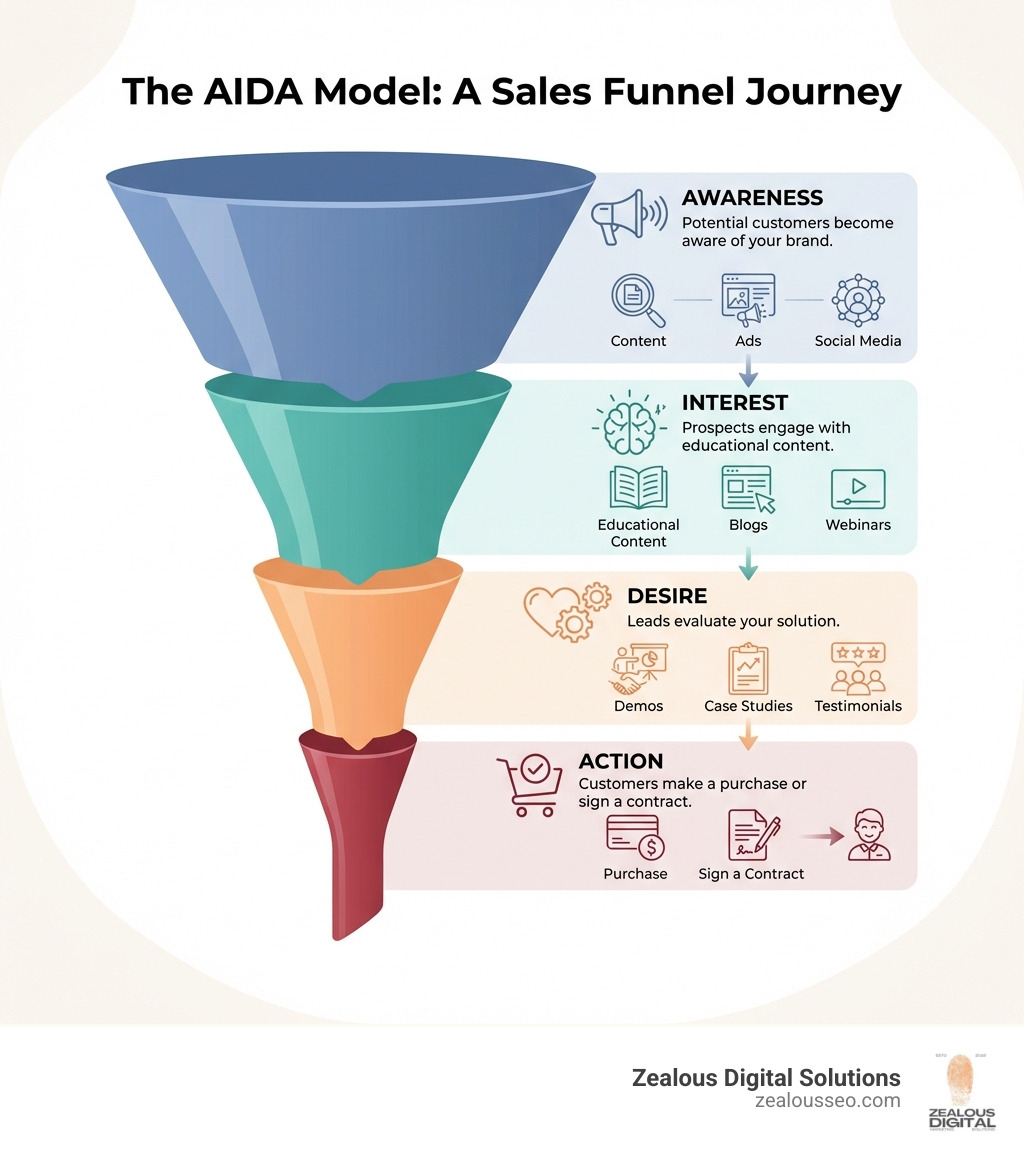
A sales funnel visualizes the customer journey, from first awareness to final purchase. A well-optimized funnel is the backbone of sustainable growth, helping you understand customer behavior and guide prospects effectively. It starts wide at the top and narrows as it filters prospects, so only the most qualified convert.
The most recognized framework for these stages is the AIDA model:
- Awareness (Top of Funnel – TOFU): Potential customers become aware of a problem and that solutions exist. The goal is to attract attention and educate, not sell.
- Interest (Middle of Funnel – MOFU): Prospects research solutions and compare options. Here, you nurture their curiosity and build trust.
- Desire (Middle of Funnel – MOFU): Prospects actively consider your offering, envisioning its benefits. The goal is to build confidence and show how you solve their specific pain points.
- Action (Bottom of Funnel – BOFU): The prospect decides to purchase. This stage must be as easy and frictionless as possible.
- Re-engage: A vital modern stage focused on turning satisfied customers into loyal brand advocates.
Since the average buyer consults 5-8 pieces of content before purchasing, having valuable content at every stage is critical. The classic AIDA model is a great starting point for understanding how buyers progress.
Sales Funnel vs. Marketing Funnel vs. Conversion Funnel
Though often used interchangeably, these terms have distinct focuses for sales funnel optimisation:
- Marketing Funnel: The broadest view, covering the entire customer experience from first touchpoint to post-purchase advocacy. It focuses on awareness and lead nurturing.
- Sales Funnel: Zooms in on the journey to a purchase, guiding engaged prospects to the point of sale. It is typically managed by the sales team to close deals.
- Conversion Funnel: The most flexible term, focusing on any specific desired action, such as a newsletter signup, demo request, or a sale. It maps a path to a single conversion goal.
Understanding these distinctions helps focus optimisation efforts and measure success appropriately.
The Evolution of the Modern B2B Sales Funnel
The traditional, linear sales funnel is a relic. Today’s B2B funnel is a complex, buyer-driven maze. Buyers conduct their own research, involve their teams, and avoid sales calls until they are close to a decision. They move at their own pace, often skipping traditional steps.
This shift means that:
- Buyer Empowerment is Key: Prospects expect to find all the information they need on their own.
- Self-Service is Preferred: Buyers want easy access to demos, pricing, and case studies to educate themselves.
- The Journey is Non-Linear: Buyers may jump between stages, revisit content, and engage with different touchpoints out of order.
This new reality is why sales leaders only get 17% of a buyer’s time during the entire process. This statistic is a wake-up call for businesses to create a seamless, self-guided experience that keeps buyers engaged. To see how your competitors are adapting, explore our Competitor Analysis Services.
Blueprint for Success: Building Your Funnel from the Ground Up
Building an effective sales funnel requires meticulous planning and strategic execution. This foundational work aligns your marketing and sales efforts by defining your audience, creating valuable content, building dedicated landing pages, and establishing lead nurturing strategies.
Defining Your Target Audience and Buyer Personas
The first step in any sales funnel optimisation strategy is understanding who you’re trying to reach. Pouring unqualified prospects into your funnel leads to leaks. Creating detailed buyer personas is the solution.
A buyer persona is a semi-fictional profile of your ideal customer based on research and real data. It should include:
- Demographics: Age, location (like Vancouver or Surrey), job title, industry.
- Pain Points: The challenges and problems they need to solve.
- Motivations: Their goals and what drives their decisions.
- Behaviors: How they research solutions and what platforms they use.
By creating personas, you ensure your messaging resonates, allowing you to target customers effectively on social media, through marketing campaigns, or with direct outreach. For a deeper dive, creating detailed buyer personas is crucial.
The Role of High-Quality Content in Sales Funnel Optimisation
Content is the fuel for your sales funnel, used to attract, educate, and persuade prospects. Since the average buyer consults 5-8 pieces of content before purchasing, you need a robust content strategy aligned with each funnel stage:
- Awareness (TOFU) Content: Educate and grab attention with useful insights. Use blog posts, short videos, social media content, and infographics. For example, this video is a prime example of awareness-stage content.
- Interest (MOFU) Content: Nurture curiosity with more detailed content as prospects research options. Use webinars, ebooks, whitepapers, and case studies.
- Desire/Action (BOFU) Content: Reinforce confidence and make it easy to convert. Use product demos, free trials, customer testimonials, and clear pricing information.
Mapping content to each stage ensures prospects get the right information at the right time. For more content strategies, explore our Blog.
Crafting Compelling Calls to Action (CTAs)
A Call to Action (CTA) guides prospects to the next step. Without clear CTAs, even great content fails to convert. Effective CTAs are direct, action-oriented, and eliminate hesitation.
For your sales funnel optimisation, consider these CTA elements:
- Action-Oriented Language: Use strong verbs like “Get Your Free Guide” or “Start Your Trial Now.”
- Clarity and Specificity: Tell the user exactly what will happen. “Watch an Interactive Demo” is better than “Learn More.”
- Design and Placement: Make CTAs visually distinct and strategically placed for intuitive clicks.
- Urgency (Used Wisely): Phrases like “Limited Time Offer” can create a nudge, but must be used genuinely.
- Relevance: Align the CTA with the content and the prospect’s funnel stage.
Continuously testing CTAs ensures they are always performing at their best. A well-designed website with prominent CTAs is crucial. Learn how we can improve your site’s functionality with our Web Design services.
Proven Strategies for Sales Funnel Optimisation
Once your funnel framework is built, optimisation begins. The goal is to fix leaks and maximize the value of every prospect by streamlining the buying process, improving conversion rates, and increasing lead generation.
Simplifying the sales process is a highly impactful strategy. Buyers expect instant answers; 30% will go to a competitor if you don’t respond quickly. Conversely, responding to leads within the first minute can increase conversions by nearly 400%. Reducing friction from complex forms or slow response times is paramount for better conversions.
Optimising Landing Pages for Maximum Impact
Landing pages are the gateway to your sales funnel, and their performance directly impacts conversions. Optimizing them is a crucial part of any sales funnel optimisation strategy.
Focus on these key areas:
- Clear Value Proposition: Immediately communicate what your offer is and how it benefits the visitor.
- Minimalist Design: Keep the page clean and focused, with every element guiding the user to the CTA.
- Fast Load Times: Slow pages are conversion killers, especially on mobile devices.
- Mobile-First Approach: With many users on mobile, a poor mobile experience means lost leads. Our Mobile Optimization Services ensure your pages are responsive and fast on all devices.
- Form Simplification: Keep forms short, asking only for essential information. Use multi-step forms for longer processes to make them less intimidating.
Leveraging Social Proof and Building Trust
People trust what others say about your business more than what you say. This is social proof, and it’s a powerful tool for sales funnel optimisation. A staggering 90% of prospects trust suggestions from family and friends, and over 75% of buyers are more likely to purchase from a business that offers a personalized experience, which includes hearing from other customers.
Here’s how to leverage social proof:
- Customer Testimonials: Feature positive quotes and success stories on your site and landing pages.
- Reviews and Ratings: Encourage and display reviews from platforms like Google and LinkedIn.
- Case Studies: Provide in-depth narratives showing how you solved a client’s problem with measurable results.
- Trust Badges: Display security certifications, industry awards, or association logos for instant credibility.
- User-Generated Content: Encourage customers to share their experiences on social media.
By showcasing these elements, you build confidence and make it easier for prospects to convert. To amplify your reach, consider our Social Media Marketing services.
Implementing Retargeting and Remarketing
Most leads don’t convert on their first visit. Retargeting and remarketing are essential sales funnel optimisation tools for re-engaging interested prospects and keeping your brand top-of-mind. Since 80% of sales happen after at least five follow-ups, persistent engagement is key.
Retargeting and remarketing help by:
- Re-engaging Lost Leads: Show targeted ads to visitors who left your site without converting.
- Running Ad Campaigns: Use platforms like Google Ads and Meta Ads to display ads to people who have interacted with your content. Our Meta Ads Services can help you create effective campaigns.
- Using Email Sequences: Nurture leads who provided an email but didn’t purchase with automated, valuable content.
- Offering Personalized Deals: Present offers based on a prospect’s previous interactions.
Moving Qualified Leads Through the B2B Funnel
Guiding qualified leads through the modern B2B funnel requires a strategic, personalized approach. This is a critical aspect of sales funnel optimisation for B2B companies.
- Personalisation at Scale: Generic messaging fails. Over 75% of buyers are more likely to purchase from a business that offers a personalized experience. Use automation to serve the right content to the right person at the right time.
- Lead Scoring: Prioritize prospects based on their attributes and actions (e.g., website visits, content downloads). This helps your sales team focus on the most promising leads.
- Sales and Marketing Alignment: Ensure sales and marketing teams have clear goals and a strong feedback loop to prevent leads from falling through the cracks.
- Timely Follow-Up: Speed is critical. Responding within the first minute can boost conversions by nearly 400%. Implement automated systems and clear processes for rapid follow-up.
Measure, Refine, Repeat: Data-Driven Funnel Mastery
Sales funnel optimisation is not a one-time project; it’s an ongoing process of continuous improvement. As customer behaviors and market dynamics shift, your funnel must adapt. The key is to move from guesswork to data-driven decisions, using a cycle of hypothesizing, testing, and learning to make small, consistent adjustments that compound over time.
Using Analytics to Monitor Funnel Performance
Analytics platforms provide a clear view of the customer journey, helping you map your funnel, identify drop-off points, and understand user behavior. This data is the foundation for every optimization decision.
Key metrics for sales funnel optimisation include:
- Conversion Rate: The percentage of visitors who complete a desired action at each funnel stage.
- Drop-off Points/Exit Rates: The stages where most prospects abandon the funnel. Tools like Google’s Goal Flow tool help visualize where users are exiting.
- Customer Acquisition Cost (CPA): The cost to acquire a new customer.
- Customer Lifetime Value (LTV): The total revenue a customer is expected to generate. A healthy LTV:CPA ratio is often around 3:1.
- Engagement Metrics: Time on site, pages per session, and bounce rate indicate how engaged visitors are.
By setting up goals in Google Analytics, you can collect data that reveals where users abandon the funnel, allowing you to identify problems and make informed adjustments.
The Power of A/B Testing
Once analytics identify problem areas, A/B testing (or split testing) is your tool for finding solutions. It provides real-time customer feedback on content and design, moving you from guesswork to data-driven certainty.
Here’s how it works:
- Test Elements: Create two versions of an element (e.g., a headline, CTA button, or image) and show them to different audience segments.
- Make Data-Driven Decisions: A/B testing provides concrete data on which version performs best.
- Test a Hypothesis: Start with a hypothesis (e.g., “A green CTA button will get more clicks than a blue one”) and run a test to validate it.
- Improve Iteratively: Test one change at a time, learn from the results, and move to the next hypothesis.
To boost your testing efforts and refine your sales funnel, explore our Conversion Rate Optimisation Services.
The Future of Sales Funnel Optimisation with AI and Technology
The future of sales funnel optimisation lies with AI and technology. These tools are essential for providing the personalized, efficient experiences modern buyers demand.
AI improves sales funnels through:
- Automation: AI handles repetitive tasks like sending email sequences and nurturing leads, freeing up your team for strategic work.
- Predictive Analytics: AI can predict which leads are most likely to convert, allowing for proactive and targeted offers.
- AI-Powered Personalisation: AI dynamically personalizes content and website experiences based on individual user behavior.
- Chatbots and AI Call Agents: AI chatbots provide 24/7 instant answers and can qualify leads. Our AI Call Agent acts as an interactive support system to streamline inquiries.
As noted in The AI Journal, “AI now serves as an interactive support system across the SaaS pipeline.” This technology empowers organizations to engage buyers better, win more often, and secure greater revenue.
Conclusion: Turn Your Funnel into a Conversion Machine
Optimizing your sales funnel is about adopting a customer-centric mindset to drive sustainable growth. By understanding your audience, crafting compelling content, and using analytics and technology, you can transform a leaky funnel into a revenue engine.
The key takeaways are:
- Understand the Modern Buyer: Respect their preference for self-service and non-linear journeys.
- Build a Solid Foundation: Define personas and map content to each funnel stage.
- Optimize Every Touchpoint: Refine landing pages, CTAs, social proof, and retargeting.
- Accept Data: Use analytics and A/B testing for continuous improvement.
- Leverage Technology: Use AI and automation for personalization and efficiency.
At Zealous Digital Solutions, we believe effective sales funnel optimisation is key to open uping your business’s potential. Our data-driven approach and expertise in SEO, web design, and paid ads deliver exceptional results for businesses across Vancouver, Surrey, Langley, and surrounding areas.
Ready to turn your funnel into a conversion machine? Transform your online presence with our expert Digital Marketing Services.


